Get Certified for Financial Modeling (FMVA)®
Gain in-demand industry knowledge and hands-on practice that will help you stand out from the competition and become a world-class financial analyst.
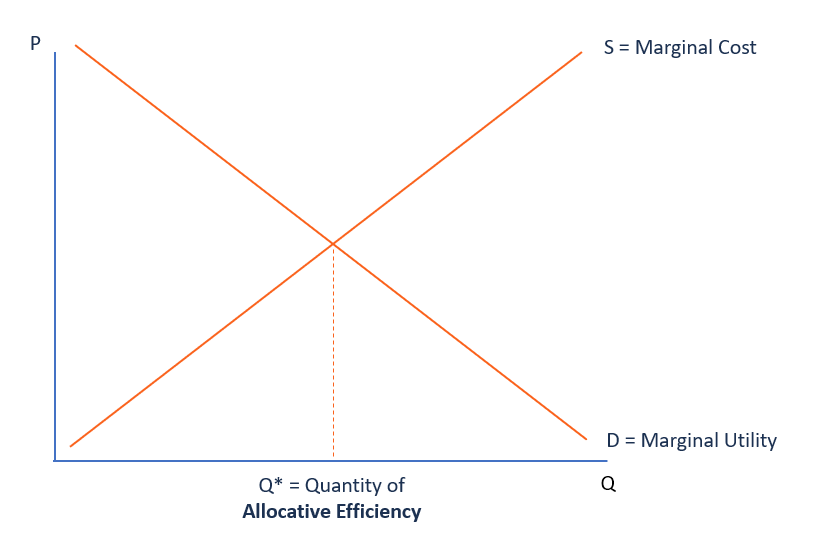
The level of output where marginal cost is as close as possible to the marginal benefits
Allocative efficiency is the level of output where marginal cost is as close as possible to the marginal benefits. It means that the price of the product or service is close to the marginal benefit that one gets from using that product or service.
Allocative efficiency occurs when market data is freely accessible to all market participants. It allows them to make informed decisions on what to purchase or produce and in what quantities.
Allocative efficiency occurs when the stakeholders, i.e., consumers and producers, are able to access market data, which they use to make decisions on resource allocation. Organizations in the private and public sectors use the concept to make decisions on the projects that will be most profitable to them and also most beneficial to the consumers.
Since resources are limited in nature, organizations must make careful decisions in how they distribute resources in order to obtain the best possible value. The goal is to achieve the ideal opportunity cost, which is the value foregone in order to put resources toward a particular project.
Due to economies of scale, the opportunity cost will first decline with increased production levels, up to a certain point. Once the production levels exceed a certain quantity, the opportunity cost will begin to increase again. As the supply increases, the demand for that product decreases since society typically starts to want it less when it becomes more readily available.
Market equilibrium is achieved when a certain amount of the individual commodity provides maximum satisfaction to society. Therefore, allocative efficiency is when goods and services are produced close to the quantity that is desired by society.
If a majority of office staff prefer navy blue suits, they will go to a clothing shop where they are sure they will get that specific color and not any other color like white, yellow, or red. For its part, the clothing store will stock more of the colors of suits that are most preferred by office staff, rather than the unusual colors that are less popular. This is because they need to dedicate more energy to the colors of suits that are most in demand. Doing so helps them earn higher profits while meeting the demand of the majority of customers.
The producer will also allocate more resources in terms of time, money, and marketing toward the production and sale of the navy blue suits. The marginal benefit (benefit of the office staff) is equal to the marginal cost (cost incurred by the clothing manufacturer to produce an additional unit of production), that is, the amount they will pay to buy the navy blue suit.
Some of the key concepts of allocative efficiency include:
The producer of a commodity allocates scarce resources depending on what consumers prefer. This does not necessarily mean that allocating resources to the production of a specific commodity is a good decision for the manufacturer.
For example, if a majority of customers buy white-colored cars, the manufacturer will allocate more resources to produce white-colored cars because they are in high demand. By doing this, the manufacturer will satisfy the needs of the majority of consumers while increasing the revenue generated from car sales.
For a market to be allocatively efficient, it must be informationally and transactionally efficient. By informationally efficient, we mean that all the necessary data about the market must be easily available and accessible to the consumers and stakeholders.
A transactionally efficient market is one where the transaction costs for goods and services are not only fair but also fair to all parties. If the cost is too expensive for one party, then it will be impossible to achieve an allocatively efficient market.
Allocative efficiency occurs when one party does not derive the benefits of a commodity at the expense of another party. Each person must be willing to exchange the commodity with another person in order for both parties to benefit.
Learn how allocative efficiency compares to productive efficiency in the table below:
| Definition | Producing the right mix of goods and services that society values most | Producing goods or services at the lowest possible cost |
| Focus | Allocation of resources (what goods are produced and in what quantities) | Method of production (how goods are produced) |
| Core Concept | Matching production with consumer preferences | Maximizing output with given resources; no waste |
| Condition for Efficiency | Resources are distributed to maximize societal satisfaction | No resources are wasted; production is at minimum cost |
| Measurement Tool | Occurs where marginal benefit equals marginal cost | Production Possibility Frontier (PPF) — operating on the curve |
| Implication of Inefficiency | Economy produces the wrong combination of goods | Economy produces less than its potential |
| Relationship to Each Other | Requires productive efficiency to fully maximize welfare | Necessary but not sufficient for overall efficiency |
| Example | Allocating 90% of GDP to guns leads to imbalance despite efficient production | Goods are produced efficiently but may not reflect what people need |
CFI is the official provider of the global Financial Modeling & Valuation Analyst (FMVA)® certification program, designed to help anyone become a world-class financial analyst. To keep advancing your career, the additional CFI resources below will be useful: