Get Certified for Financial Modeling (FMVA)®
Gain in-demand industry knowledge and hands-on practice that will help you stand out from the competition and become a world-class financial analyst.
The cost of providing one additional unit of a product or service
The marginal cost of production may be defined as the costs incurred for each extra output produced. For example, when a factory is operating at maximum capacity, processing additional products will require overtime pay for the workers.
Generally, the marginal cost of production tends to rise as the quantity being produced goes up. Through marginal cost, the manufacturer can determine how to allocate resources among the production units and maximize output.
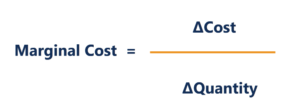
The Marginal Cost of Production is the cost to provide one additional unit of a product or service. It is a fundamental principle that is used to derive economically optimal decisions and an important aspect of managerial accounting and financial analysis. It can be calculated as:
If a company’s total cost of production is defined as:

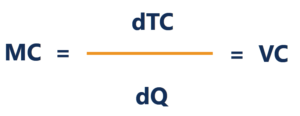
Then its marginal cost is the first order derivative of the total cost function. In this case, the marginal cost is directly equal to its variable costs.
Where:
Companies in competitive markets measure the size of the output to be produced with respect to the marginal cost of production and the pricing per unit. If the market price is higher than the marginal cost, they may consider producing an additional unit and selling it. However, if the marginal cost of production is greater than the selling price, it will not be commercially viable to produce the unit.
However, costs may not vary directly on a per unit basis. It is possible that increasing production by a unit may not cause a proportional increase in costs. It is because different business activities face different forms of cost behaviors.
Unit costs would be the traditional idea of variable costs where an increase in a single unit of production leads to a proportional increase in costs. For example, the cost of materials required to produce another coffee mug.
Batch costs would vary not by the individual unit of production but by the number of batches for a given number of units produced. Taking the coffee mug example further, a ceramic shaping machine may need to be brought up to an optimal temperature before production may begin. Beyond this point, there are no additional costs to operate this machine until production is stopped. Beginning the next batch would then incur this startup cost once more.
Product costs occur regardless of the number of batches or units produced. This is a cost that is attributed directly to a particular item on a product portfolio. For instance, the cost to design and market a holiday variant of a coffee mug would not be affected by the number of mugs produced.
Customer costs are incurred by the number of customers serviced instead of any particular level of production or expansion of a product line. This could be in the form of after-sales service or legal costs resulting from a contractual agreement.
Organizational sustaining costs are costs that are incurred as a result of general business operations. These are costs that are incurred regardless of any quantity of production. These might include such things as the fixed salaries of employees at a company or auditing fees for preparing financial statements to shareholders.
Marginal cost is a valuable concept for optimizing production via economies of scale. A producer seeking to maximize profits will generate more output to the point where the marginal revenue is equivalent to the marginal cost of production.
In most scenarios, fixed costs remain unchanged against various levels of production. However, maximizing the output will lead to the reduction of fixed cost per unit since the total cost is allocated across a larger number of production units.
After examining the marginal cost of production, the manufacturer can analyze the total cost of processing an additional product and conclude whether to add one or more units in their line of production. Sometimes, producing a certain amount of additional units can create economies of scale and cut down the overall cost across all production units.
The marginal cost of production comprises the following types of cost:
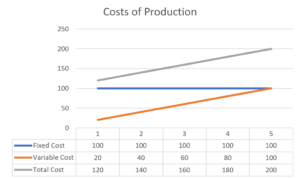
Variable costs vary with the changing levels of outputs, and they rise incrementally with the increasing number of units produced. For example, a shoemaker requires sixty cents for leather and plastic for each shoe made. Leather and plastic are variable costs as the costs increase as the quantity of shoes produced increases.
Fixed costs remain constant and do not change with a decrease or increase in production output. An example is the rent paid for the shoe factory facility. The costs are spread across all production units and, on a per unit basis, will decrease with increased levels of output.
Short-run marginal cost is incurred when the additional output is produced only on a short-term basis. During the short-run production, the company may own a fixed amount of assets and, therefore, may decide to decrease or increase the production levels considering the available number of assets.
The long-run marginal cost of production is the increased cost incurred during production when every input is variable. It is the additional cost that results when a company scales up its operations by adding more employees, expanding a factory, or venturing into a new market.
For example, Coffee Mug Company faces an annual cost of $100,000 in the form of organization sustaining costs. The material and labor costs required to produce a single coffee mug are $5/unit. For every batch of 100 units, Coffee Mug needs to warm up its machines at a cost of $1,000.
Typically, the cost to design and market a product line comes to $10,000. As a result of Coffee Mug’s business model targeting wholesalers and large retailers, it services a few large customer accounts that require servicing costs of $2,000 per account.

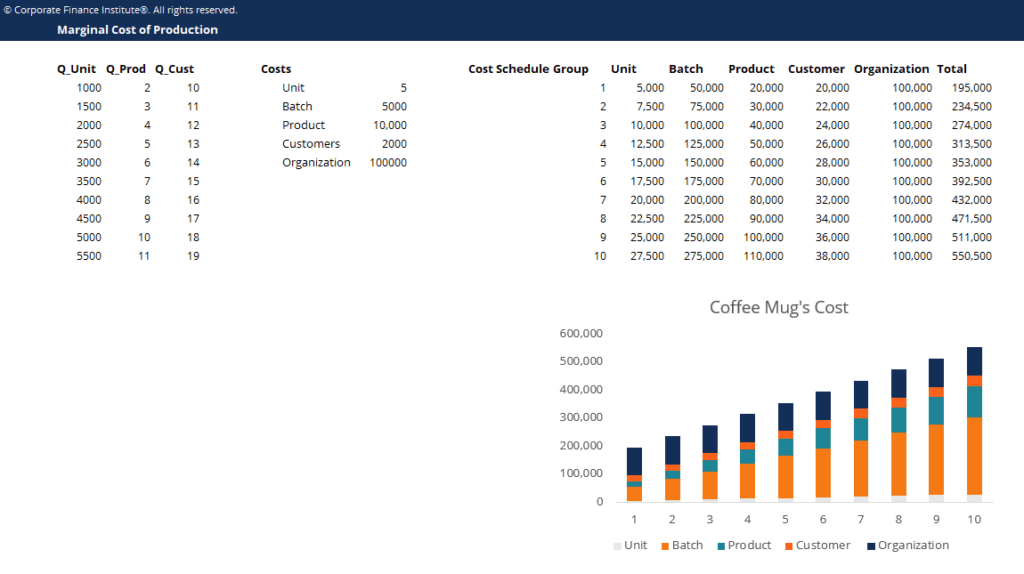
In this example, marginal costs for various activities exist. The marginal cost for one additional unit produced is either $5 for any unit except the 101st, 201st, etc. where the marginal costs would be $1,005. The marginal cost of introducing a new product line would be $10,000. Servicing one additional customer would cost $2,000.
When will a firm find the optimal level of production? A firm will continue to produce additional units as long as the marginal costs are less than the marginal revenue.
After determining the relationship between the marginal cost of production and marginal revenue, it is easier for a company to plan production levels and put in place per unit pricing strategies. Knowing marginal cost enables the organization to determine and come up with an optimal revenue margin for sustaining sales and increasing profits.
The marginal cost of production is used to measure the change in the cost of a product resulting from the production of an extra unit of output. When the company reaches the optimum production level, producing additional units will increase the cost of production per unit. For example, overproduction beyond a specific level may require overtime pay for workers and increased machinery maintenance costs.
If the marginal cost per unit is high, then increasing production capacity will be expensive. On the other hand, a low marginal cost of production may mean that a company is able to achieve economies of scale by working with lower fixed costs in some production lines.
Companies operating with economies of scale produce more units of output at a lower cost. Therefore, the production of additional units becomes cheaper, hence maximizing their profits while minimizing the marginal cost of production.
However, companies working with diseconomies of scale experience higher production costs per unit as more outputs are produced. For example, when a company that already reached its optimum production capacity wants to produce more, it will incur high marginal costs of production since the factory’s capacity will require expansion.
Click the button below to download our free Marginal Cost of Production template!
* By submitting your email address, you consent to receive email messages (including discounts and newsletters) regarding Corporate Finance Institute and its products and services and other matters (including the products and services of Corporate Finance Institute's affiliates and other organizations). You may withdraw your consent at any time.
This request for consent is made by Corporate Finance Institute, #1392 - 1771 Robson Street, Vancouver, BC V6G 3B7, Canada. www.corporatefinanceinstitute.com. [email protected]. Please click here to view CFI`s privacy policy.
CFI is the official provider of the global Financial Modeling & Valuation Analyst (FMVA)™ certification program, designed to help anyone become a world-class financial analyst. To keep advancing your career, the additional resources below will be useful:
Below is a break down of subject weightings in the FMVA® financial analyst program. As you can see there is a heavy focus on financial modeling, finance, Excel, business valuation, budgeting/forecasting, PowerPoint presentations, accounting and business strategy.
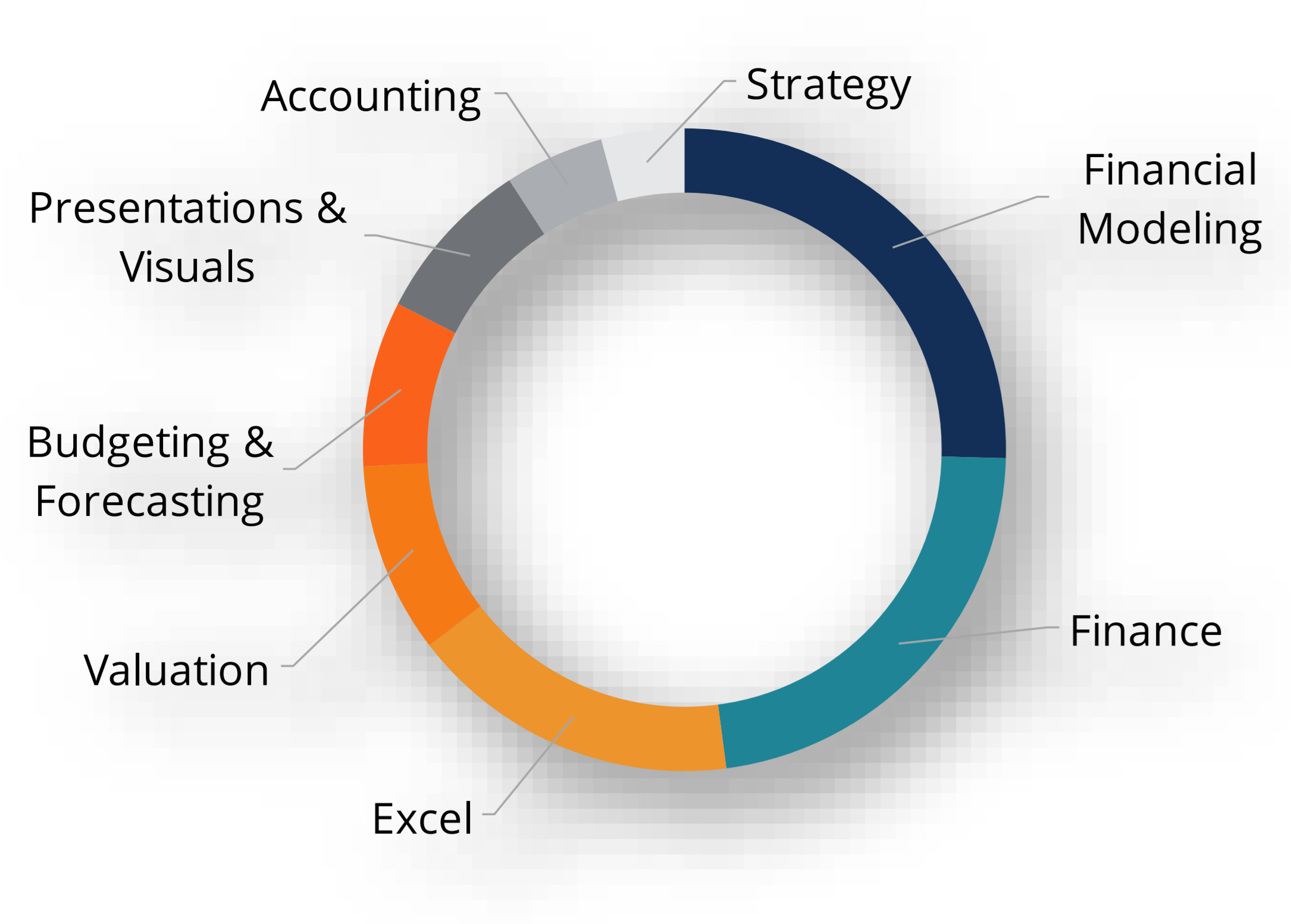
A well rounded financial analyst possesses all of the above skills!
CFI is the global institution behind the financial modeling and valuation analyst FMVA® Designation. CFI is on a mission to enable anyone to be a great financial analyst and have a great career path. In order to help you advance your career, CFI has compiled many resources to assist you along the path.
In order to become a great financial analyst, here are some more questions and answers for you to discover: